 Solid Toolkit
Free: printable CRA mileage log
A printable log with every CRA field, plus a logbook checklist.
Kits / Mileage Log and Car Claim Workbook (Canada)
A mileage log book spreadsheet for the self-employed in Canada and for employees who claim car costs. Log each business trip with the date, destination, purpose and km, as the CRA asks. Track what the car costs, and see the business part of those costs. A record keeper, not tax advice.
CA$9One-time price. Instant ZIP download, with our 14-day promise. The kit lists each official page we used and the date we checked it.
What you download: A spreadsheet workbook (.xlsx), a filled-in sample copy, an 8-page PDF guide and a README. Formulas only, no macros.
Not ready to buy? Get the free printable CRA mileage log first. CA$0, instant download.
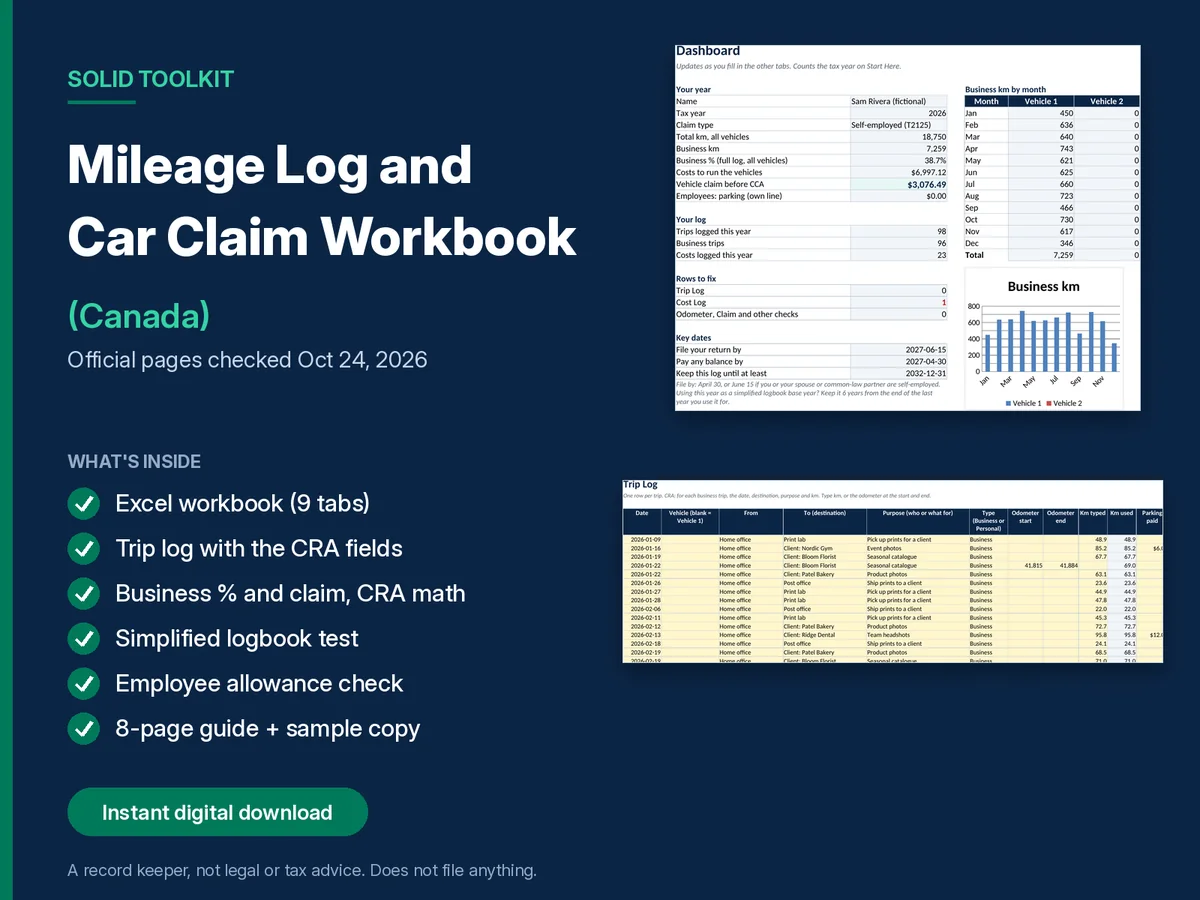
In short: This workbook is a mileage log book for your CRA records. It is for the self-employed in Canada (Form T2125) and for employees who claim car costs (Form T777). It does 3 jobs:
Solid Toolkit made this workbook. It is not from or endorsed by the CRA, the Department of Finance Canada or the Government of Canada. It does not file anything or work out capital cost allowance (CCA). It is a record keeper, not tax advice.
CA$9, one-time price, instant download, with our 14 day refund promise. Not ready to buy? Try the free printable CRA mileage log first.
Try it with our 14-day promise. Every part is listed in What is inside below.
Want the rules first? Read our free guides: what a CRA mileage log must show and CRA mileage rate for the self-employed.
Good fit if:
Not a fit if:
Not sure? Read the refund promise below. You have 14 days to try it.
The CRA says your log should show the date, destination, purpose and km of each business trip, plus your odometer at the start and end of the year. Then you add it all up, split business from personal, and apply that share to a year of gas, insurance and repairs. A paper log does not do the math. A missed trip or a lost odometer reading is hard to fix later.
Formulas only, no macros. Tested in Google Sheets and LibreOffice, not in Excel. Yellow cells are for you, grey cells are formulas.
Select a picture to make it bigger. All names and numbers are made up.
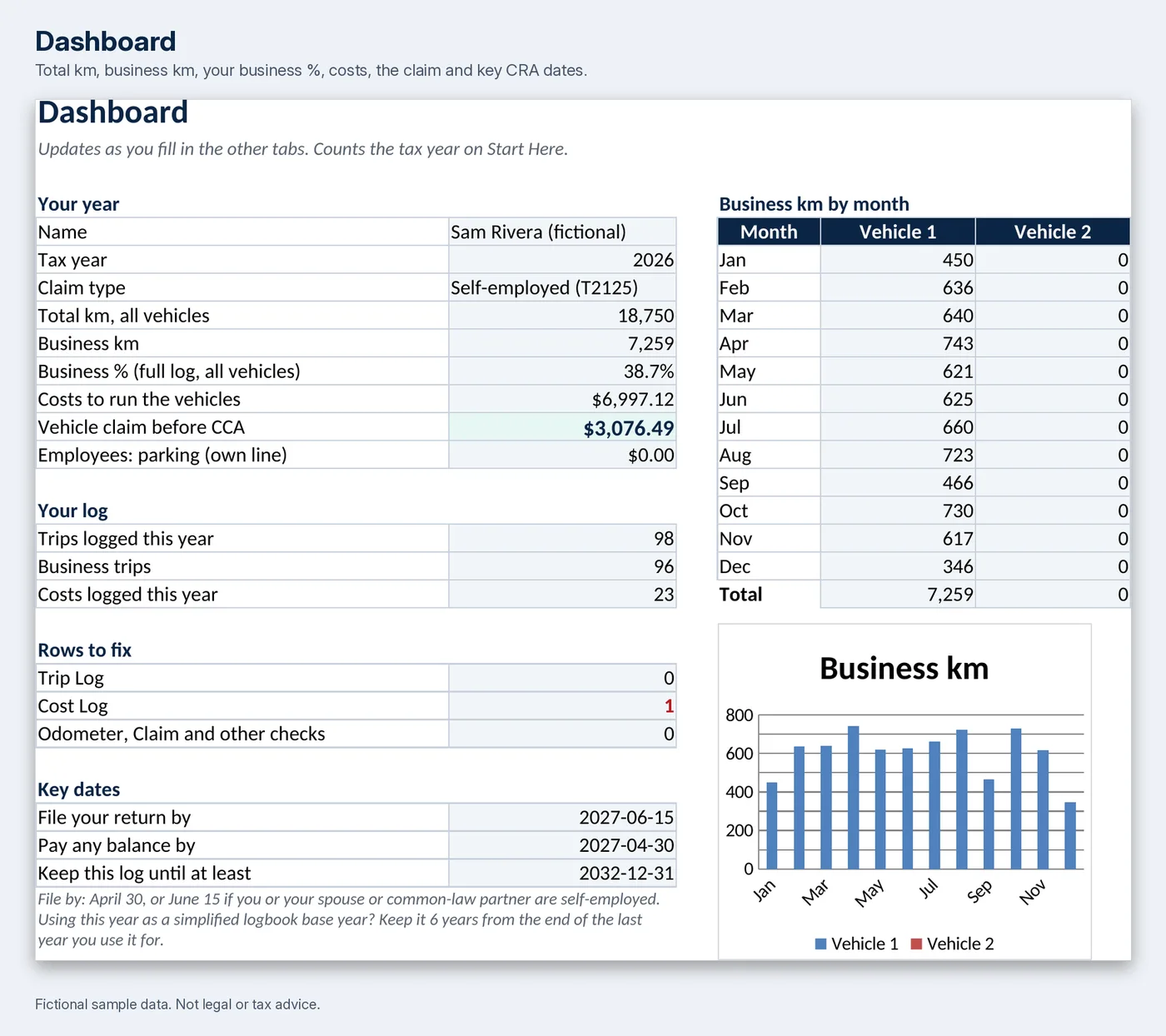
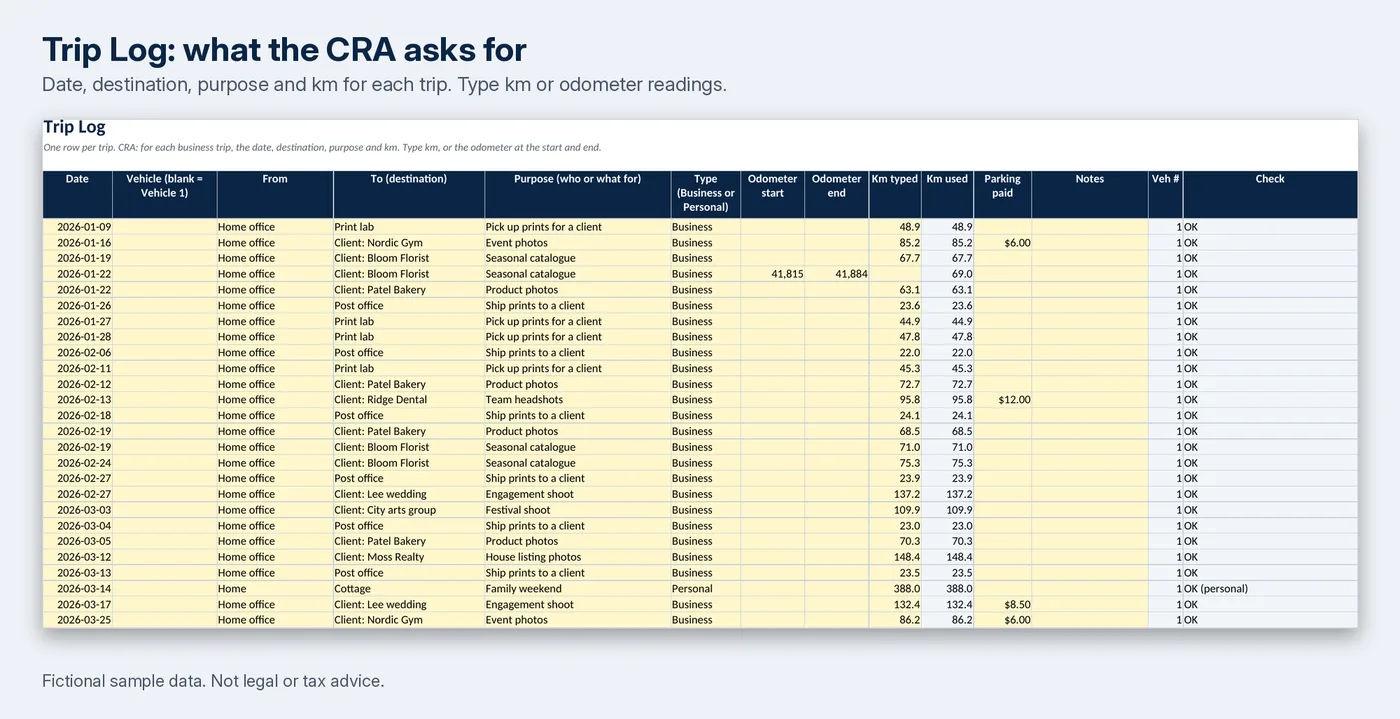
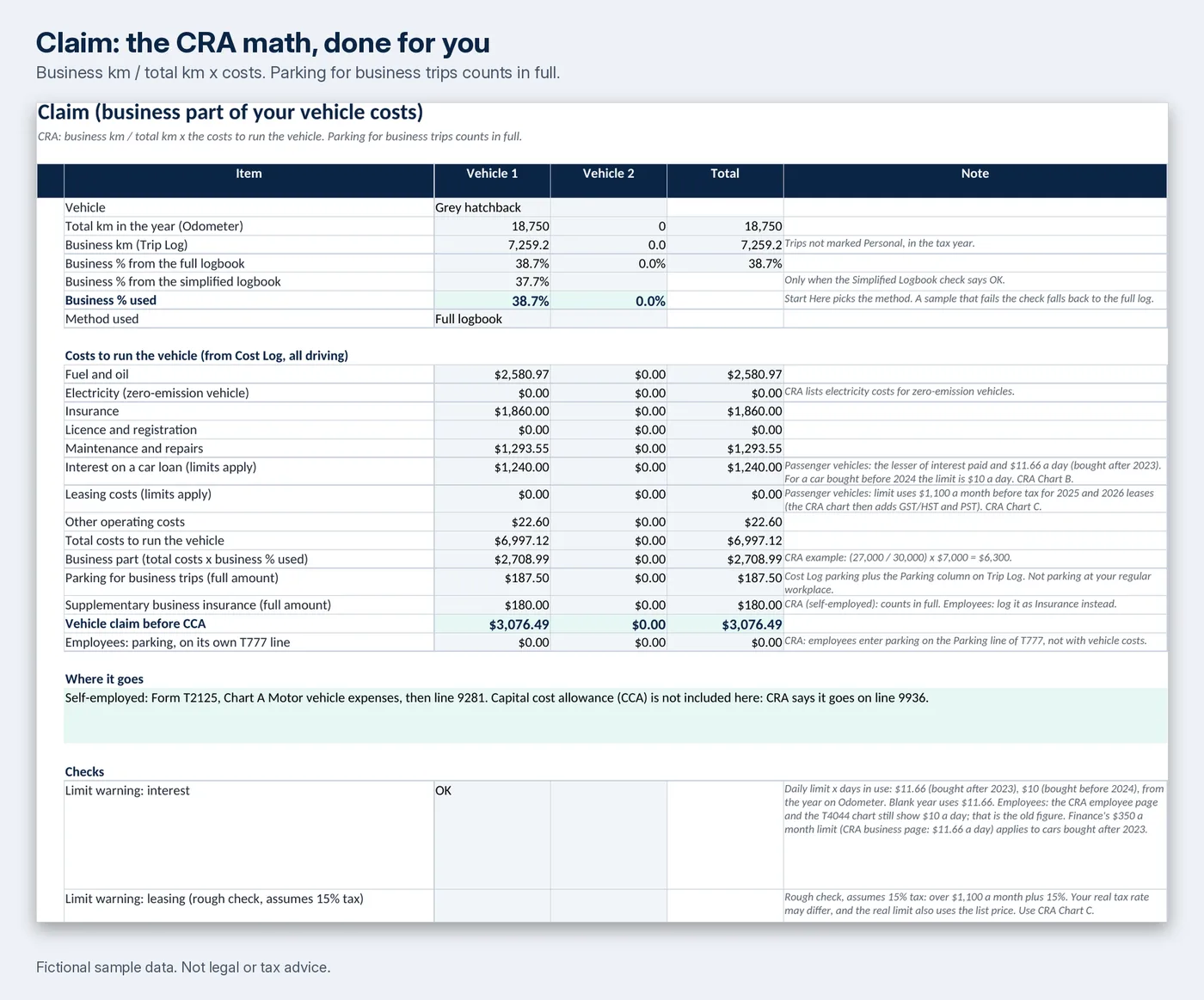
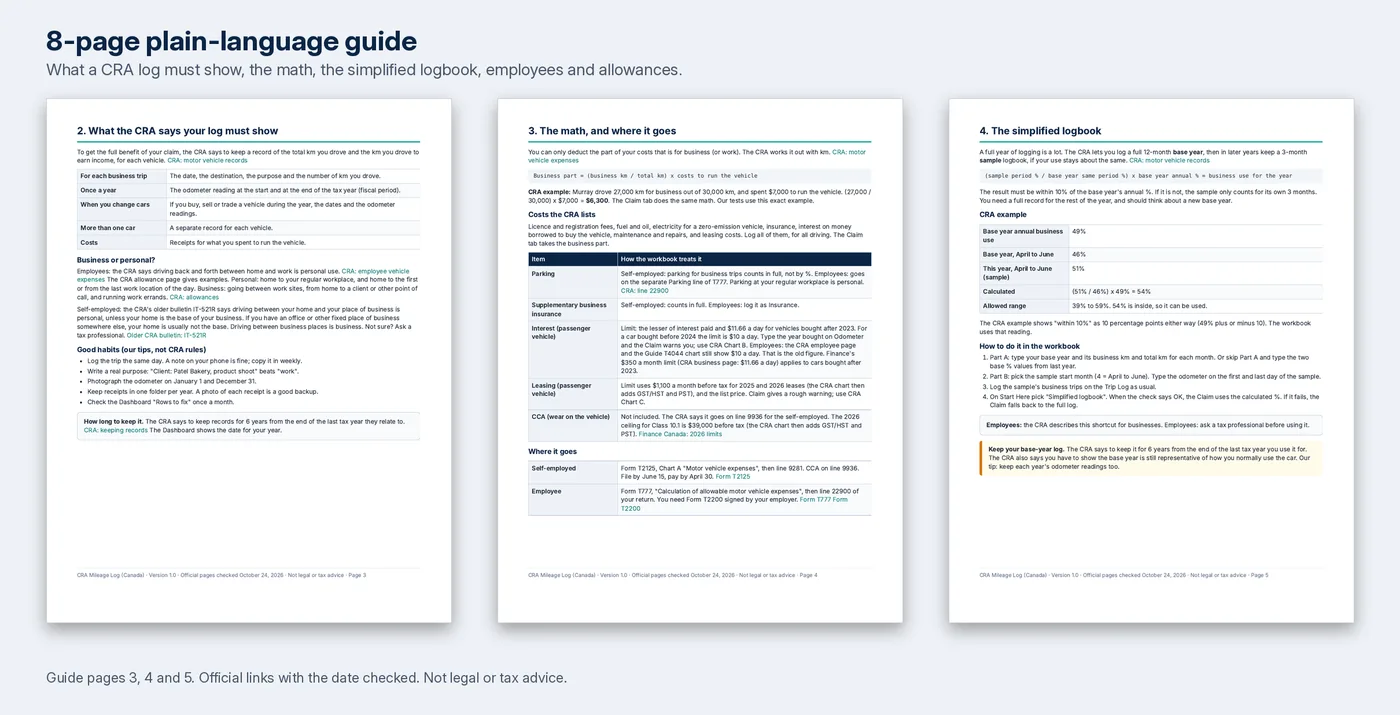
The CRA says to keep a record of the total km you drive and the km you drive to earn business income, for each vehicle. Its motor vehicle records page lists what the log should show:
In the workbook, the Trip Log has the date, where you left from, the destination, the purpose and the km of each trip. The Odometer tab is set up for a calendar year. It takes the reading on January 1, or the day you got the car, and on December 31, or the day you sold it, for up to 2 vehicles. Our guide what a CRA mileage log must show explains each rule, with official links.
Here is part of one week for Rosa, the made-up realtor in the example below. Each row has the fields the CRA lists. The Trip Log has the same columns and adds up the km for you.
| Date | From | To | Purpose | Km |
|---|---|---|---|---|
| 2026-03-02 | Brokerage office | 14 Oak Crescent, London | Listing photos with the seller | 11 |
| 2026-03-03 | Brokerage office | 220 Ridge Road, Komoka | Show the house to a buyer | 23 |
| 2026-03-05 | 220 Ridge Road, Komoka | Law office, Dundas Street | Drop off the signed offer | 19 |
| 2026-03-06 | Brokerage office | Print shop, Wellington Road | Pick up open house signs | 7 |
| Business km this week | 60 | |||
Rosa also types her odometer reading on January 1 and December 31. Her full year is in the example below.
There is room for 2 vehicles, 1,000 trips and 500 costs. Use one workbook per tax year.
Rosa and her trips are made up. Not legal or tax advice. Rules change, so check the official pages before you act.
Rosa is a made-up self-employed realtor in London, Ontario, used only on this page. Her numbers for the year:
| Item | Amount |
|---|---|
| Total km (odometer December 31 minus January 1) | 15,000 km |
| Business km (sum of the Trip Log) | 9,000 km |
| Business % | 9,000 / 15,000 = 60% |
| Car costs: fuel $2,500, insurance $2,000, repairs $880, licence $120 | $5,500 |
| Business part of costs | 60% x $5,500 = $3,300 |
| Parking for business trips (added in full) | $200 |
| Claim before CCA | $3,500 |
The CRA says self-employed people can deduct business parking in full, so it is not cut to 60%. The Claim tab does this for you. CCA on the car itself is not included.
No. You type each trip, or copy it in from your phone notes. Many people find a quick note at the end of each drive is enough.
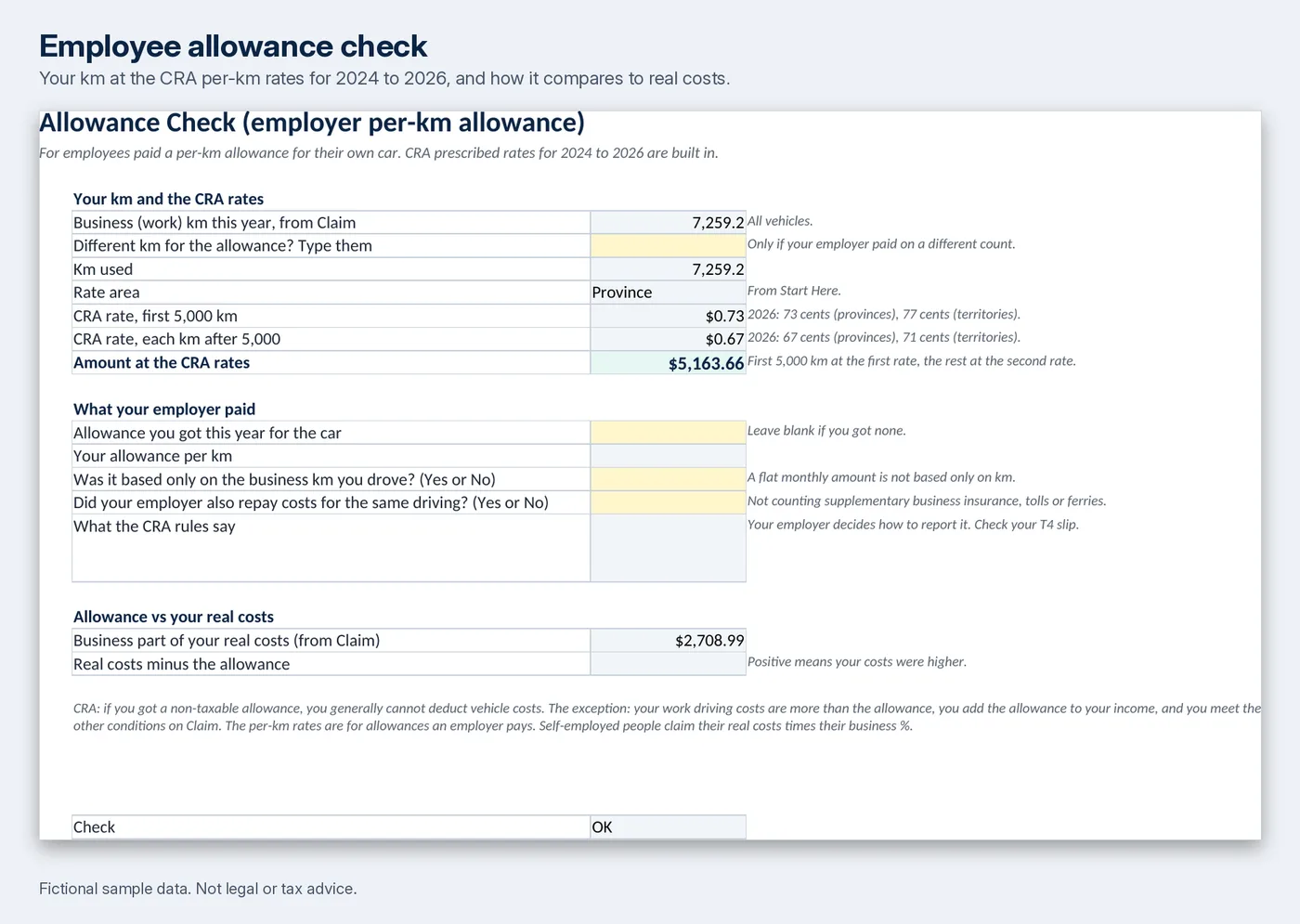
Yes, if you pay your own car costs and your employer gives you Form T2200 for Form T777. The Allowance Check tab also compares a per-km allowance from your employer with your real costs.
That is a rate for per-km allowances an employer pays, not a deduction you take yourself. For 2026, it is 73 cents a km for the first 5,000 km and 67 cents a km after that in the provinces. Self-employed people claim the business part of their real costs. Our guide CRA mileage rate for the self-employed explains why.
Up to 2. If you run more vehicles, or a corporation's vehicles, this kit is not a fit.
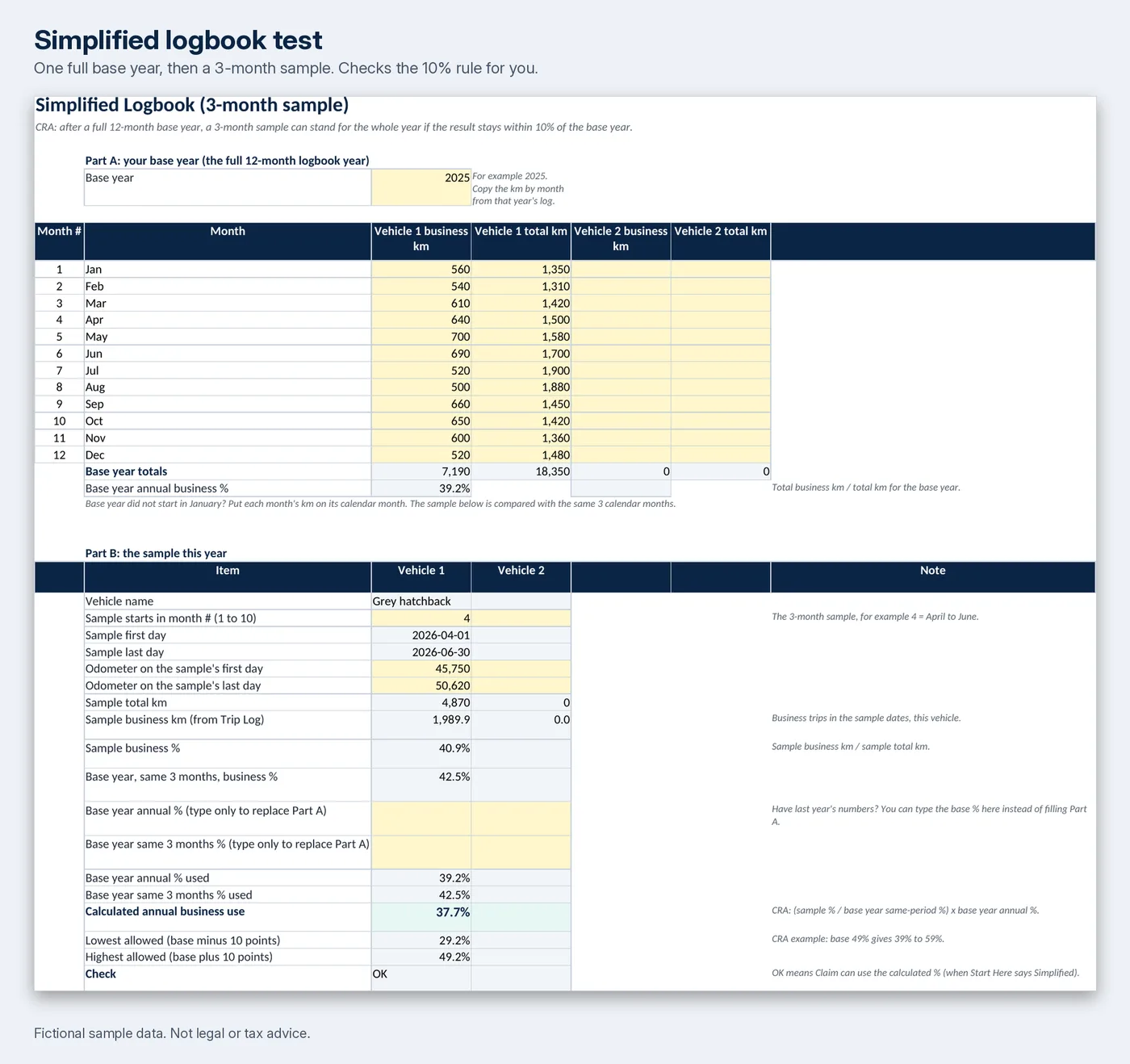
Yes. After one full base year, you can keep a 3-month sample. The Simplified Logbook tab runs the CRA 10% test and tells you if the sample can stand for the year.
Yes. The free printable CRA mileage log has a column for every CRA field and odometer boxes.
For each business trip, the CRA says to keep a log of the date, destination, purpose and number of kilometres you drive. It also says to record the odometer reading of each vehicle at the start and end of the fiscal period. The Trip Log and Odometer tabs have a place for each. Our guide What a CRA mileage log must show covers the rules.
If you use the car for business and personal driving, the CRA says you can deduct only the part of the expenses that relates to earning business income. The CRA list includes licence and registration fees, fuel and oil, insurance, interest on money borrowed to buy a motor vehicle, maintenance and repairs, and leasing costs. You can deduct business parking fees and supplementary business insurance in full. Capital cost allowance (CCA) goes on its own line, and the kit does not work it out. For passenger vehicles, the CRA limits how much interest, leasing costs and CCA you can deduct.
The CRA says an allowance is not taxable if all of these apply: it is based only on business kilometres, the per-kilometre rate is reasonable, and your employer did not also reimburse you for the same use of the car (repaid supplementary business insurance, tolls or ferry charges do not count, if the allowance was set without them). It also says that if no record is kept, the allowance or reimbursement is generally taxable.
Generally, the CRA considers an allowance at its prescribed per-km rates reasonable. For 2026, those rates are 73 cents a km for the first 5,000 km and 67 cents after that in the provinces, and 77 and 71 cents in the territories.
The Allowance Check tab compares your allowance with the CRA rates for your province or territory. Our guide CRA mileage rate for the self-employed explains what the rates are for.
Generally, the CRA says to keep records for 6 years from the end of the last tax year they relate to. A full 12-month logbook used as a base year must be kept for 6 years from the end of the tax year it was last used to show business use. Our tip: keep one workbook per tax year.
No. Solid Toolkit made this workbook. It is not from the CRA. The CRA pages we checked list what a mileage log should show, but they do not give an official log form. We renamed the kit, but the file names inside the ZIP still start with CRA-Mileage-Log. What is inside is the same.
Yes, if it shows what the CRA lists. The CRA accepts records kept on paper or in an accessible and readable electronic format. Each business trip needs its date, destination, purpose and km, plus the odometer reading at the start and end of the period. This workbook is a spreadsheet. You type or paste each trip into the Trip Log.
For employees, the CRA says driving between home and work is personal use. For the self-employed, the CRA's archived bulletin IT-521R says the same, unless your home is the base of your business. Not sure? Ask a tax professional. Our guide what a CRA mileage log must show has more detail.
Yes. It is a spreadsheet workbook (.xlsx). It was tested in Google Sheets and LibreOffice, not in Excel. In Google Sheets, choose File, Import, Upload, pick the .xlsx file, then choose Replace spreadsheet. Formulas only, no macros.
Our reading: it is another name for a mileage log, the record of the driving you do for work. The CRA calls it a logbook. It says the best evidence to support the use of a vehicle is an accurate logbook of business travel kept for the entire year, showing the destination, the reason for the trip and the distance covered for each business trip. If you use more than one vehicle for your business, it says to keep a separate record for each one. In the kit, the Trip Log is your logbook. There is room for 2 vehicles and 1,000 trips.
For 2025, the CRA lists 72 cents a km for the first 5,000 km and 66 cents a km after that in the provinces, and 76 and 70 cents in the territories. Our reading: Ontario is a province, so the province rates are the ones for Ontario. Generally, the CRA considers an allowance at these prescribed rates reasonable. They are rates for a per-km allowance an employer pays, not a deduction you take yourself. The Allowance Check tab has the CRA rates for 2024 to 2026.
The CRA says to fill in Chart A, Motor Vehicle Expenses, of Form T2125 to work out the motor vehicle expenses you can deduct. In its example, the amount goes on line 9281 of Form T2125. It says capital cost allowance (CCA) goes on line 9936 instead. For employees, the CRA says to enter the amounts in the Calculation of Allowable Motor Vehicle Expenses area of Form T777. In the kit, the Start Here tab points the self-employed to line 9281 of Form T2125, and the Claim tab shows your claim before CCA.
Our reading: not from the CRA. The CRA pages we checked list what a mileage log should show, but they do not give an official log form or an Excel template. This workbook is a mileage log template made by Solid Toolkit. Its Trip Log has the date, destination, purpose and km of each trip, and the Odometer tab has the readings for the start and end of the year. It is a spreadsheet workbook (.xlsx). We tested it in Google Sheets and LibreOffice, not in Excel.
The answers above come from these official pages.
CA$9, one-time. Instant download.
Open the kit and use it for 14 days. If it does not fit, email support@solidtoolkit.com and we refund the full price you paid for the kit. No reason needed. If something in the kit is wrong or does not work, we will fix it and send you the fixed file, or refund you if you prefer. Read the full refund policy.